5 signs your legacy system is quietly costing you money
Ageing systems rarely crash, they leak. Five signs your legacy setup is quietly costing you money, and what to do about it.


5 signs your legacy system is quietly costing you money
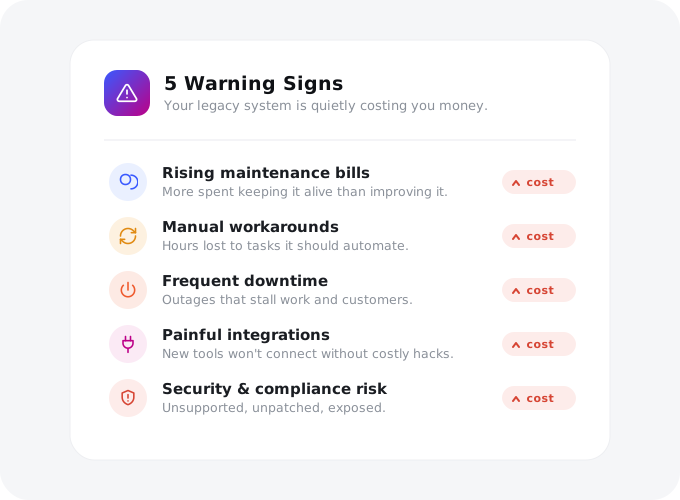
Legacy systems rarely fail dramatically. They don't crash and force your hand. Instead they leak — time, money, and opportunity — slowly enough that the cost feels normal. By the time the number is obvious, you've been paying it for years. Here are five signs your ageing systems are costing you more than you think, and how to start doing something about it.
1. Your infrastructure bill grows faster than your business
If your hosting and infrastructure costs rise every year regardless of how the business is doing, you're likely paying for capacity you don't use. Older systems tend to be over-provisioned — sized for a peak that rarely comes and unable to scale down when demand is quiet. So you pay peak prices around the clock.
Modern, elastic infrastructure charges you for what you actually use, scaling down as readily as it scales up. The gap between "always paying for the maximum" and "paying for the actual" is often startling — and it compounds every single month.
2. Every change takes far longer than it should
When a small feature or a routine fix turns into a multi-week ordeal, the system is telling you something. Tangled, ageing codebases make every change risky. One small edit might break three things nobody expected, so every change is approached cautiously, tested exhaustively, and shipped slowly.
That drag isn't just an engineering frustration. It's lost revenue every time you're too slow to respond to the market, too slow to fix what customers are complaining about, too slow to ship the thing that would have won the deal. Speed of change is a competitive weapon, and legacy systems quietly disarm you.
3. Your team props things up with manual workarounds
Spreadsheets bridging two systems that don't talk. A person who "just knows" how to run the nightly process. Steps that only work if done in a particular order by a particular someone. A report that takes half a day to assemble by hand every week.
Manual workarounds are the tax you pay for systems that were never properly modernised. They're dangerous for two reasons: they don't scale — the workload grows with the business — and they concentrate risk in individual people. When the person who "just knows" is on leave, or leaves, the workaround becomes a crisis.
4. It strains or breaks under load
If a busy day, a marketing campaign, or a seasonal spike makes you nervous rather than excited, your infrastructure can't keep up with your ambition. Systems that buckle under success are actively capping your growth — you're forced to avoid the very things that would grow the business, because you're not sure the system will survive them.
The worst version of this is invisible: opportunities you never pursue because, somewhere in the back of your mind, you know the system can't take it.
5. Security and compliance keep you up at night
Older systems are harder to secure, harder to patch, and harder to prove compliant. Dependencies fall out of support. Patches stop coming. The knowledge of how it all fits together fades as people move on.
In an environment with the Australian Privacy Act and GDPR to answer to, "we're not quite sure" is an expensive position to be in — not just in potential penalties, but in the deals you can't close because you can't demonstrate you handle data properly.
How to put a number on it
Vague worry doesn't drive decisions; numbers do. A rough tally is usually enough to make the case:
- Infrastructure waste: what are you paying now versus what an elastic, right-sized setup would cost? The difference is annual, recurring savings.
- Slowed delivery: how many weeks a year does your team lose to the friction of changing the old system? Multiply by their cost.
- Manual effort: how many hours a week go into workarounds? Multiply by 52.
- Missed opportunity: what have you not attempted because the system couldn't handle it?
You rarely need precision. Even rough figures tend to make the cost of doing nothing uncomfortably clear.
What to do first
The good news is that none of this requires ripping everything out and starting again. Modernisation can be staged — assessing what you have, then migrating and re-architecting onto modern, cloud-native foundations without disrupting the business. The leak stops, and what replaces it costs less and does more.
The sensible first step is small: an honest assessment that maps what you're running, where the biggest leaks are, and what to fix first. You don't have to commit to everything. You just have to see clearly.
If two or more of these signs sound familiar, it's worth putting a number on what your current systems are really costing. That's usually where the conversation starts — and where the savings do too.
Latest Articles