You can't fix what you can't see: an introduction to observability
Most teams learn their system is broken from a customer. Observability is how you see problems first explained without the jargon.


You can't fix what you can't see: an introduction to observability
Most teams find out their system is broken the worst possible way: a customer tells them. By then the damage is done — the frustration felt, the trust dented, the sale lost. The teams that avoid this aren't luckier. They can simply see inside their systems, so they catch problems before users do. That capability has a name: observability. And it's less complicated than it sounds.
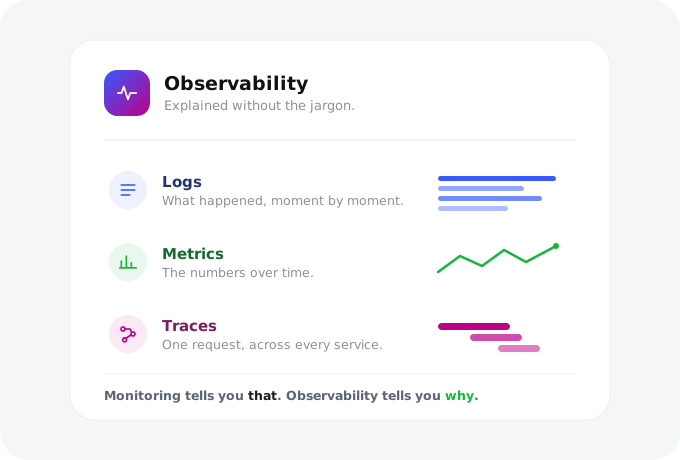
Monitoring tells you that. Observability tells you why.
There's a useful distinction here. Traditional monitoring answers a yes/no question: is the system up? It's the smoke alarm — it tells you something is wrong, but not what or where.
Observability answers the harder, more valuable question: what exactly is happening inside the system, and why? It's the difference between knowing there's a fire somewhere and knowing it's an electrical fault in the kitchen. When something slows down or fails, monitoring tells you there's a problem. Observability gives you the information to understand and fix it — fast.
You need both. But as systems grow more complex — more services, more moving parts — the "why" becomes the thing that actually saves you time.
The three things worth collecting
Observability rests on three kinds of signal, often called the three pillars.
Logs are the detailed record of what happened — the events, the errors, the story of each moment. When you need to know exactly what occurred at 2:47am, logs are where you look. The catch is volume: logs are only useful if they're centralised and searchable, not scattered across a dozen machines.
Metrics are the numbers over time — response times, error rates, requests per second, memory usage. They're the vital signs of your system, cheap to collect and perfect for spotting trends and triggering alerts. Metrics tell you that something is off and roughly where; they rarely tell you the full why on their own.
Traces follow a single request across every service it touches, start to finish. In a modern system where one user action might hit five or six services, a trace shows you exactly which step was slow or where it failed. Traces are what turn "the app is slow" into "this specific call to this specific service is taking four seconds."
Together, they turn a black box into something you can actually see into.
What it looks like in practice
Concretely, an observable system has:
- Centralised logging, so everything's searchable in one place instead of scattered everywhere.
- Live dashboards showing the health of the whole system at a glance.
- Real-time alerting, so the right people know the moment something crosses a line — before customers do.
- Distributed tracing, to follow requests across services and pinpoint bottlenecks.
- Error tracking that captures exceptions with the context needed to actually fix them.
- Performance monitoring that surfaces slowdowns before your users feel them.
Getting started without boiling the ocean
You don't need all of this on day one, and trying to instrument everything at once is a common way to get nowhere. A sensible order: start with the basics that catch the most pain. Get centralised logging and a few key metrics in place first — that alone moves you from "blind" to "seeing." Add alerting on the handful of things that genuinely indicate trouble, so you're notified without being buried in noise. Then layer in tracing as your system grows more distributed and the "which service?" question gets harder to answer by hand.
The goal isn't maximum instrumentation. It's enough visibility to answer the questions you actually ask when something goes wrong.
A word on alert fatigue
One caution: more alerts is not more safety. Teams that alert on everything quickly learn to ignore all of it, and the one alert that mattered gets lost in the noise. Good observability is as much about alerting on the right things as collecting everything. An alert should mean "a human needs to act." If it doesn't, it's noise wearing an alarm's clothing.
Why it's worth it
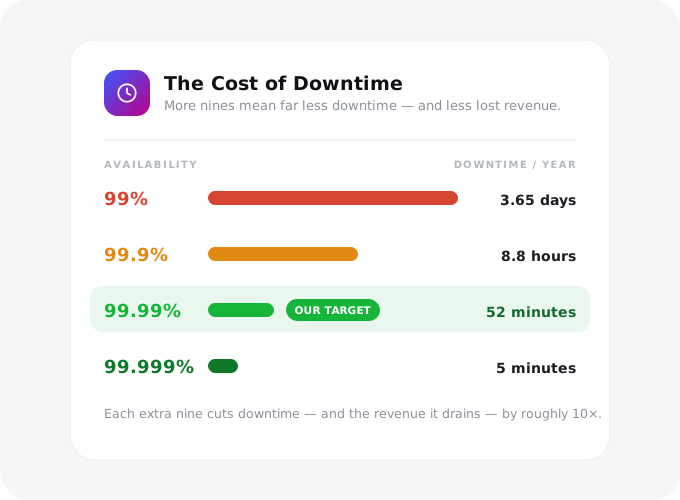
The payoff is straightforward. Problems surface in seconds instead of arriving as complaints. Root causes are found in minutes instead of hours, because the data is already there. Downtime shrinks because issues are caught early. And you ship with confidence, knowing you'll see any impact instantly rather than hoping for the best.
There's a quieter benefit too: real data about how your product is actually used becomes the best guide to what to build next. Observability isn't only for emergencies — it's a steady source of truth about your system and your users.
See first, then fix
You can't fix what you can't see — and you can't improve what you can't measure. Observability is what turns "something's wrong" into "here's exactly what, and here's the fix."
At Protechly, observability is one of the five principles behind everything we build — because a system you can see is a system you can trust, improve, and grow.
Latest Articles