Taking an offline business online into a modernisation playbook
A practical playbook for turning manual, paper-based, or offline operations into software that scales — one sensible step at a time.


Taking an offline business online into a modernisation playbook
A practical playbook for turning manual, paper-based, or offline operations into software that scales — one sensible step at a time.
Not every business that needs modernising is running old software. Plenty are running on paper, spreadsheets, phone calls, and the knowledge in people's heads. It works — until it doesn't scale, doesn't travel, and can't be in two places at once. Bringing an offline business online isn't about chasing trends. It's about turning manual effort into something that compounds. Here's how to think about it.
Start with the process, not the software
The instinct is to go looking for an app. The better first move is to map how the business actually runs today: what happens, in what order, who does it, and where things get stuck or repeated.
Sit with the people doing the work and trace a real example from start to finish. You'll almost always find the same things: steps done twice because two systems don't talk, information rekeyed by hand, decisions waiting on someone to be back at their desk. Almost every offline business has a handful of processes that eat disproportionate time. Those are where digitisation pays off first — not everything at once, but the workflows that hurt most.
Turn manual work into software
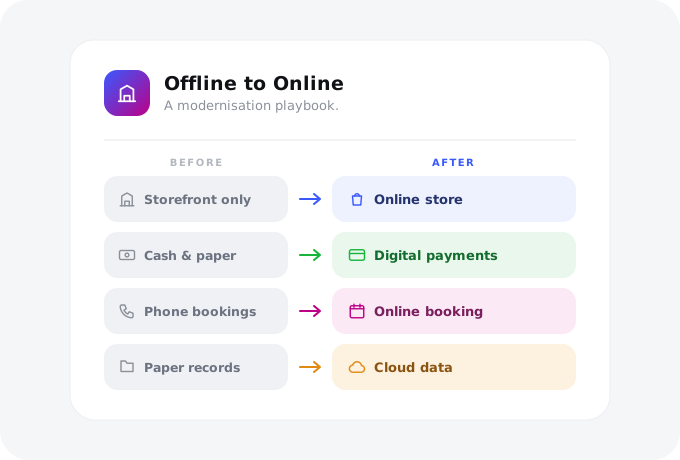
Once you can see the process clearly, the manual steps become candidates for software: forms instead of paper, a shared record instead of a filing cabinet, automated notifications instead of chasing people, calculations done instantly instead of in a spreadsheet someone maintains by hand.
The goal isn't to digitise for its own sake — it's to remove the repetitive, error-prone work so your team can spend time on what actually needs a human. A good rule of thumb: if a task is done the same way every time and follows clear rules, software can probably do it. If it needs judgement, keep the human and give them better tools.
Put your services where your customers are
Offline businesses are limited by presence — you can only serve who's in front of you or on the phone. Bringing services online removes that ceiling. Customers can book, order, enquire, or self-serve from anywhere, at any hour, without adding to your team's load.
Done well, this doesn't just cut cost; it widens what the business is capable of. A booking system that runs overnight is taking orders while everyone sleeps. A self-service portal answers the same twenty questions your team fields every day, freeing them for the ones that actually need them. Online isn't just cheaper — it's a bigger version of the business.
Bring your data into one place
Scattered records — some on paper, some in spreadsheets, some in someone's inbox — are the quiet killer of an offline business trying to grow. You can't see the whole picture, you can't trust the numbers, and you spend more time reconciling than deciding.
Centralising data into one reliable source of truth is often the single most valuable step. Suddenly you can see the whole business at a glance, make decisions on real numbers, and stop rekeying the same information five times in five places. It's also the foundation everything else builds on — automation and online services both depend on trustworthy, centralised data underneath.
A quick worked example
Take a small services business booking jobs by phone, writing them in a diary, and invoicing from a spreadsheet. The offline version caps at how many calls one person can take, loses jobs when the diary is misread, and invoices late because someone has to remember. The online version: customers book through a form that checks availability, jobs land automatically in a central schedule, reminders go out on their own, and invoices generate from the completed job. Same business — but now it can handle three times the volume without three times the staff.
The human side: change management
Here's the part that sinks more digitisation projects than any technical issue: people. A new system that the team resents or works around is worse than the paper it replaced. The trick is to involve the people doing the work early, digitise the processes that make their lives easier first (so the tool earns trust), and roll out in stages rather than forcing a hard switch. Software adoption is as much about people as it is about code.
Do it in stages, safely
The mistake is trying to transform everything overnight. The playbook is the same as any good modernisation: assess, prioritise, and roll out in controlled stages, so the business keeps running throughout. Each stage should stand on its own and earn its keep before the next begins.
The payoff
An offline business brought online properly is a fundamentally more capable one — able to serve more customers, with less manual effort, on data it can actually trust. At Protechly, we help businesses make that shift onto modern, cloud-native foundations, one sensible step at a time. Tell us how you run today, and we'll map the path.
Latest Articles