The true cost of downtime and how high availability pays for itself
Downtime isn't a rare catastrophe you insure against, it's a steady cost you're already paying. Why high availability pays for itself.


The true cost of downtime and how high availability pays for itself
When people budget for reliability, they tend to think of it as insurance — a cost you grudgingly pay against a bad day that might never come. That framing undersells it badly. Downtime isn't a rare catastrophe you insure against. It's a steady, compounding cost that shows up in ways most businesses never add up. High availability isn't insurance. It's an investment that pays for itself.
Downtime costs more than the outage
The obvious cost of an outage is the revenue you don't earn while you're down. That's real, but it's the smallest part. The larger costs come after:
- Customers who tried and couldn't, and quietly went elsewhere — some of them for good.
- Sign-ups and purchases abandoned mid-flow, many of which never come back to finish.
- Support flooded with tickets, at exactly the moment your team is busy firefighting.
- Trust dented — and trust, once dented, is slow and expensive to repair.
A ten-minute outage can cost you far more than ten minutes of sales. The meter keeps running long after the system comes back up.
The costs you can't see on the invoice
There's also the internal cost, and it's larger than most teams admit. Every outage pulls your best engineers off building the future and into fighting a fire. It resets roadmaps, burns goodwill, and adds a layer of caution to everything the team does afterwards.
Systems that fail regularly make organisations timid. People stop shipping on Fridays. Deploys become rare, nervous events. The whole business slows down, not because of the outages themselves, but because of the fear of the next one. Reliability, or the lack of it, quietly sets the pace of everything.
Understanding "the nines"
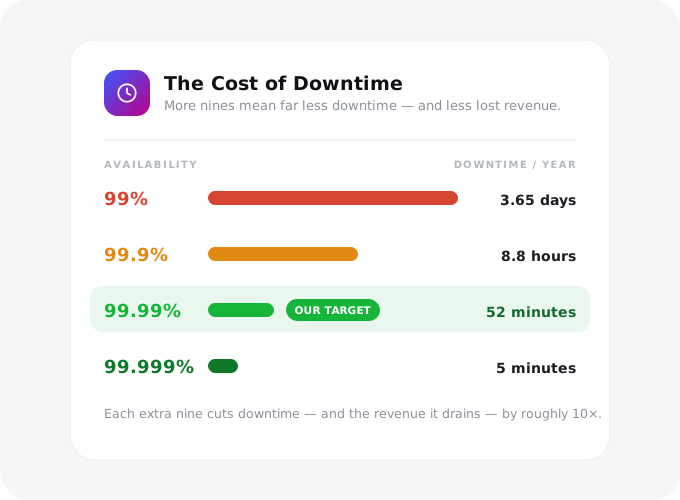
You'll hear availability described in nines. It's worth understanding, because the gaps are bigger than they look:
- 99% uptime sounds excellent — until you realise it allows over three days of downtime a year.
- 99.9% ("three nines") allows about nine hours a year.
- 99.99% ("four nines") allows under an hour a year.
- 99.999% ("five nines") allows about five minutes a year.
Each extra nine is roughly ten times less downtime — and each is harder to reach. The point isn't to chase the most nines possible; it's to decide, deliberately, how much downtime your business can actually afford, and to engineer for that.
How to calculate your downtime cost
Here's the calculation worth doing. It's rough, and rough is fine:
- Estimate the fully loaded cost of one hour of downtime — lost revenue, lost customers who don't return, support load, engineering time pulled onto firefighting, and a sensible allowance for reputational damage.
- Estimate the hours you realistically lose in a year at your current level of reliability.
- Multiply. That's your annual cost of downtime.
- Compare it to the cost of engineering for higher availability.
For most businesses of any scale, the maths isn't close. The cost of the outages already dwarfs the cost of preventing them.
What high availability actually buys
High availability means designing systems that keep running when things go wrong — because things always go wrong. In practice:
- Redundancy, so there's no single point of failure.
- Multiple availability zones, so one datacentre issue doesn't take you offline.
- Automatic failover, so traffic reroutes to healthy infrastructure in seconds.
- Health checks, that quietly detect and replace failing components before anyone notices.
- Zero-downtime deployments, so shipping updates never means going dark.
- Automated, tested backups, so even in the worst case, data is recoverable.
The result isn't the absence of failure — it's the absence of outages. Things still break. Your users just never find out.
Reliability as a feature
Your most reliable competitor has an advantage that's hard to see and harder to beat: customers who never have a reason to leave. Uptime is a feature — one your users feel every day, even when they can't name it. Nobody writes a glowing review because your service was available, but plenty leave when it wasn't.
At Protechly, high availability is one of the five principles behind everything we build. Always on isn't a promise we bolt on. It's how the system is designed — because the cheapest outage is the one that never happens.
Latest Articles