Australian Privacy Act & GDPR. Staying compliant as you grow
Compliance doesn't have to be a handbrake. How building privacy in from the start turns the Australian Privacy Act and GDPR into an advantage.


Australian Privacy Act & GDPR. Staying compliant as you grow
Compliance has a reputation as the thing that slows everything down — a wall of paperwork and legal caveats that arrives late and kills momentum. It doesn't have to be that way. When privacy and compliance are built into how you engineer, rather than bolted on before an audit, they stop being a handbrake and start being a competitive advantage. Here's how to think about it as a growing business.
This article is general information, not legal advice — for your specific obligations, talk to a qualified professional.
Why it lands on your desk sooner than you think
Founders often assume compliance is a "later" problem — something for when you're big. But if you handle personal information about people in Australia, the Australian Privacy Act already applies. If you have users, customers, or even prospects in the EU or UK, GDPR applies too, regardless of where your business is based.
The obligations don't wait for you to reach a certain size. They arrive with your first relevant user. And retrofitting compliance onto a product that was built without it in mind is exactly the kind of expensive rework that makes compliance feel like a punishment. Built in early, it's barely noticeable. Bolted on late, it's a project of its own.
The principles behind both
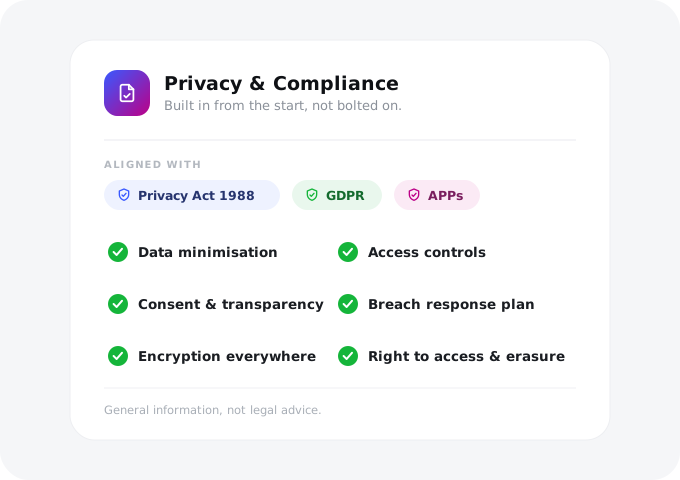
The good news is that the Australian Privacy Act and GDPR rhyme. Both are built on the same sensible ideas:
- Collect only what you need. If you don't collect it, you don't have to protect it, store it, or explain it.
- Be clear about why. People should understand what you're collecting and what you'll do with it.
- Keep it secure. Reasonable steps to protect the data you hold, appropriate to its sensitivity.
- Let people access and correct their information. They have rights over their own data.
- Don't keep it forever. Hold data only as long as you actually need it, then dispose of it properly.
Build to those principles and you're most of the way to satisfying both regimes at once, without having to treat them as two separate projects.
Privacy by design
The cheapest compliance is the kind you never have to retrofit. Privacy by design means making these principles part of how the system is built:
- Minimise the data you collect and store from the outset.
- Encrypt it in transit and at rest, so a breach of storage isn't a breach of everything.
- Control access tightly — least privilege applies to personal data more than anything.
- Be able to delete it cleanly when you should, which is far harder if you didn't plan for it.
- Log access and changes, so you can show what happened when someone asks.
Do this from the start and compliance becomes a natural property of the system rather than a scramble before an audit.
Common mistakes to avoid
A handful of missteps come up repeatedly:
- Collecting data "just in case." Every field you capture is a liability you now have to justify, secure, and eventually delete. If you don't have a clear use, don't collect it.
- No plan for deletion. Systems are usually built to store data, rarely to remove it. When someone exercises their right to be forgotten, "we can't easily delete that" is not an answer.
- Treating consent as a checkbox. Burying data practices in fine print no one reads satisfies neither the law nor your users.
- Assuming location protects you. Being based in Australia doesn't exempt you from GDPR if you serve people in the EU or UK.
- Forgetting third parties. The tools and services you pass data to are part of your compliance picture too.
Being audit-ready without the panic
Audits are stressful when you have to reconstruct what happened after the fact. They're straightforward when your systems already log access, track changes, and enforce controls as a matter of course.
"Audit-ready" isn't a state you rush into before an assessment — it's a byproduct of good engineering that's simply there whenever you need it. If someone asks who accessed a record, when it was changed, or how it's protected, the answer is a query, not a crisis.
A practical starting checklist
If you want somewhere to begin: know what personal data you collect and why; make sure it's encrypted in transit and at rest; restrict who and what can access it; have a clear, honest privacy notice; be able to export and delete a person's data on request; and keep basic records of access and changes. None of these are exotic — they're the foundation both regimes are built on.
Compliance as trust
Handled well, compliance stops being a defensive chore and becomes something you can lead with. Being able to say — and prove — that you handle data properly is increasingly what serious customers and partners look for before they'll work with you. In many deals, it's now a gate you have to pass. Privacy done right isn't just protection; it's a reason to choose you.
At Protechly, we build to recognised security standards with privacy designed in, aligned to the Australian Privacy Act and GDPR — so staying compliant is something your product does by default, not something you fight for as you grow.
Latest Articles