Claude on Amazon Bedrock
Using Claude with Australian customer data? How Bedrock's AU inference profiles keep processing in Sydney and Melbourne, and what to check.


Plenty of Australian businesses want to put AI to work, then stall on one question: where does our data actually go? If you hold personal information, work in a regulated sector, or have clients with strict contracts, that question deserves a precise answer. The good news is there is one. Claude can be run on Amazon Bedrock so that requests are processed inside Australia — as long as it's set up deliberately.
Why location matters
Under the Privacy Act and the Australian Privacy Principles, sending personal information offshore isn't automatically forbidden, but it does carry obligations. APP 8 deals with cross-border disclosure, and in many cases your business stays accountable for how an overseas recipient handles that information. On top of the law, many client contracts, security questionnaires and industry frameworks simply ask for data to stay onshore.
So "we use AI" isn't enough. You need to be able to say which service, which region, and how you know.
How Claude runs on Amazon Bedrock
Amazon Bedrock is AWS's managed service for foundation models, and Anthropic's Claude models are available through it. That means Claude runs inside your own AWS account, under the same controls you already use for everything else: IAM permissions, CloudTrail logging, KMS encryption and your existing AWS billing.
AWS states that Bedrock doesn't use your prompts and responses to train models, and that model providers don't have access to them. For most businesses, that alone answers the first round of questions from legal and security teams.
The detail that matters: inference profiles
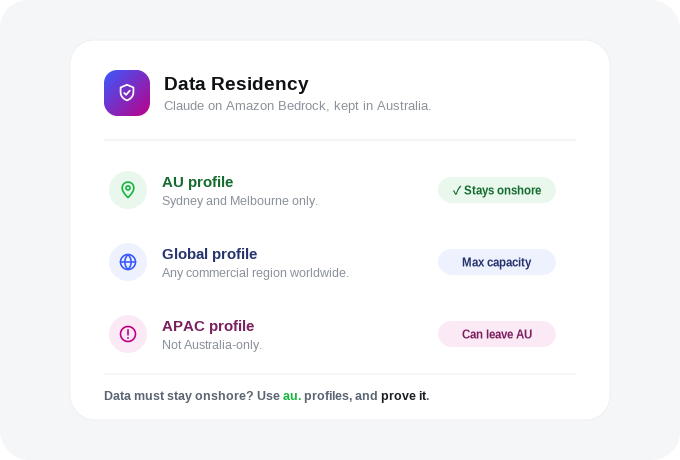
Here's where it gets specific. Newer Claude models on Bedrock are called through inference profiles, which decide where your request is actually processed. There are three kinds worth knowing:
- Global profiles route requests to any supported AWS commercial region worldwide. Great for capacity, but no residency guarantee.
- Geographic profiles keep requests inside one geography. The Australian profile — model IDs starting with
au.— routes only between Sydney (ap-southeast-2) and Melbourne (ap-southeast-4). - The APAC profile is not Australia-only. Requests sent through it can be processed in other Asia Pacific regions, such as Tokyo, Singapore or Mumbai. It's an easy mistake to make, because "APAC" sounds close enough. It isn't.
If your data needs to stay in Australia, use the au. profile and nothing else.
Check which models are available
Not every Claude model gets an Australian profile on day one. New releases often arrive on global routing first and reach the AU profile later. Before you commit to a model, check its model card in the AWS documentation for current AU availability — and build your application so the model ID is a configuration setting, not something hard-coded. That way, upgrading to a newer model when it lands in Australia is a config change, not a rebuild.
Proving it, not just promising it
Residency is only as good as your ability to show it. Two AWS features make that practical:
- CloudTrail records which region served each Bedrock request, so you can audit where processing really happened.
- Service control policies can block any inference profile that isn't
au.at the account level. That stops a well-meaning developer from switching to global routing to fix a capacity issue at 11pm.
And don't forget everything around the model. The documents you retrieve, the vector database, the logs and the backups all need to live in Australian regions too. Residency is a property of the whole system, not just the AI call.
A practical checklist
- Run your workloads in the Sydney region (ap-southeast-2).
- Call Claude only through
au.inference profiles. - Add a service control policy that denies non-AU profiles.
- Keep supporting data — storage, search indexes, logs — in Australian regions, encrypted with KMS.
- Turn on CloudTrail and check the region that served your requests.
- Document the setup for your privacy impact assessment and your clients.
- Re-check AU availability whenever you upgrade models.
The trade-offs
Australian routing has less spare capacity than global routing, the newest models may arrive a little later, and pricing can differ from global options — check current Bedrock pricing for your model. For most businesses handling personal or sensitive data, those are small prices for an answer you can give a regulator, an auditor or a client with confidence.
Clear answers, built in
Data residency shouldn't be the reason a good AI project never starts. When a client needs their data to stay in Australia, this is the setup we start from at Protechly: Claude on Amazon Bedrock, Australian routing, and the controls to prove it.
Latest Articles