Five places to start with AI in a growing business and two to avoid
Not sure where AI fits? Five everyday places it pays off early for growing businesses, two to leave until later, and how to choose.


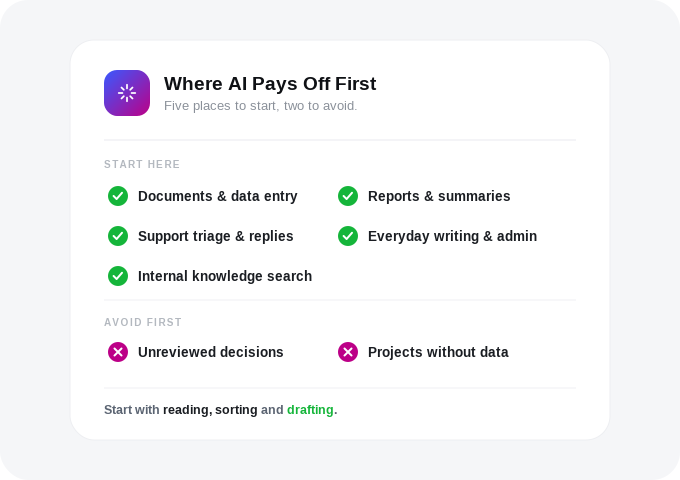
"We should be using AI" is easy to say and hard to act on. The tools are capable, the headlines are loud, and it's not obvious where to begin. The answer is usually less glamorous than the headlines: start where your team spends hours on reading, sorting and writing. Here are five places where AI tends to pay off early — and two that are better left until later.
1. Documents and data entry
Invoices, application forms, contracts, purchase orders, supplier statements. Many businesses still have people reading documents and retyping what's in them. AI is very good at pulling the right fields out of messy documents, checking them against your rules, and flagging anything unusual for a person to look at. The work goes from hours of typing to minutes of checking.
2. Customer support triage and drafted replies
Every support inbox has the same pattern: a large share of messages are routine, and they all need to be read, categorised and answered. AI can sort incoming requests by topic and urgency, pull the relevant details from your systems, and draft a reply in your tone for a team member to review and send. Customers get faster answers, and your team spends its time on the conversations that actually need a human.
3. Internal knowledge search
How much time does your team lose looking for the right policy, the latest price list, or the answer someone gave in an email last year? An AI assistant connected to your documents can answer questions in plain language and point to the source it used. New starters get up to speed faster, and experienced staff stop being interrupted for the same answers.
4. Reports and summaries
Weekly reports, meeting notes, project updates, board packs. Much of this is gathering information from several places and turning it into a clear summary. AI can do the first draft in seconds, leaving people to add the judgement and context only they can provide.
5. Everyday writing and admin
Proposals, follow-up emails, job ads, product descriptions, internal announcements. Used well, AI gets the first draft on the page quickly and consistently, in your house style. It's often the easiest place to start, and a good way for a team to build confidence before tackling bigger projects.
Two to avoid first
Fully automated decisions that affect customers. Approving refunds, assessing claims, giving legal, financial or medical guidance with no one checking. AI can help with all of these, but as a first project, the risk is too high and the trust isn't built yet. Start with AI that drafts and recommends, with a person deciding.
Projects without access to the data they need. An AI assistant that can't see your systems will give generic answers, and generic answers don't save anyone time. If the data is locked away, scattered or messy, fix that first — or pick a project where the data is ready.
What the good first projects have in common
- They happen often, so small time savings add up quickly.
- They're mostly reading, sorting and drafting, not high-stakes judgement.
- A person can easily check the output before it matters.
- The data is available and can be handled securely.
- Success is measurable — hours saved, faster turnaround, fewer errors.
Start small, then build on it
The businesses getting the most from AI rarely started with a moonshot. They picked one well-chosen, everyday problem, proved it worked on their own data, and built from there. At Protechly, that's how we approach every AI implementation: practical, measurable, Claude-powered solutions that fit the way your business already works.
Latest Articles