Is Amazon Bedrock a local LLM? How it protects confidential data
Amazon Bedrock isn't a local LLM, but it's built for confidential data. How it keeps prompts private, and what you still need to set up.



When we suggest Claude on Amazon Bedrock for a project involving confidential data, the first question is usually some version of: "So it's a local model, running on our own servers?" It isn't. But for most businesses, what Bedrock actually offers is closer to what they need than a local model would be.
Not a local LLM, a managed AWS service
A local LLM runs on hardware you own and operate. Amazon Bedrock is a fully managed AWS service: the models run on AWS infrastructure in the AWS Region you choose, and you call them from inside your own AWS account, under the same identity, network and logging controls you already use for everything else.
That distinction matters. You don't buy GPUs, patch model servers or manage capacity. You do get an enterprise-grade environment designed for sensitive workloads, with security controls you can configure and audit.
How Bedrock handles confidential data
- Model providers can't see your data. Each model provider's software is deployed into AWS-owned accounts that the provider can't access. AWS states that providers like Anthropic have no access to your prompts, your responses or Bedrock logs.
- Your data doesn't train the models. AWS states that your prompts and responses aren't used to improve the base models, and that when you fine-tune a model you work on a private copy.
- No prompt logging unless you switch it on. Bedrock doesn't store your prompts and responses by default. Model invocation logging is off until you enable it, and when you do, the logs go to your own Amazon S3 bucket or CloudWatch account for your own auditing.
- Private network paths. With AWS PrivateLink, applications in your VPC can reach Bedrock through a private endpoint, so traffic stays on the AWS network instead of crossing the public internet.
- Encryption you control. Data is encrypted in transit and at rest, and you can use AWS Key Management Service (KMS) to create and manage your own encryption keys.
A note on compliance
You'll often see Bedrock described as "certified" for HIPAA or GDPR. The accurate version is this: Bedrock is in scope for ISO and SOC compliance programs and CSA STAR Level 2, it is HIPAA eligible, and it can be used in a way that complies with GDPR. Those are strong foundations, but compliance is a shared responsibility. AWS secures the service; you are still responsible for how your application uses it.
What you still need to get right
Bedrock gives you the controls. Using them well is part of the build:
- Least-privilege access. Use IAM so only the services and people who need Bedrock can call it.
- Private connectivity. Set up a PrivateLink endpoint for production workloads.
- A deliberate logging decision. If you enable invocation logging for auditing, treat those logs as confidential data, with encryption and tight access.
- The data around the model. Knowledge bases, vector stores, documents and backups need the same protection as the prompts themselves.
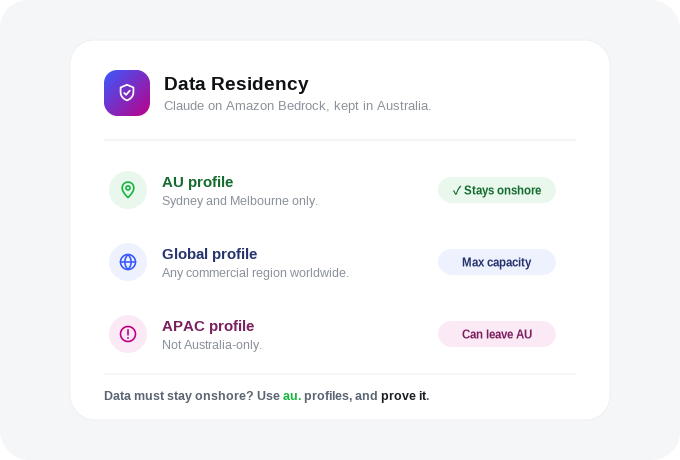
- Region choice. If data must stay in Australia, choose the right region and inference profile. We cover that in Claude on Amazon Bedrock: keeping AI data in Australia.
What this looks like in practice
We recently built an internal AI copilot for a Sydney-based startup's live chat support team. Agents ask it how to handle complex questions, such as why a customer's account was restricted, and Claude suggests accurate, context-aware answers. Because the copilot handles confidential company and customer information, it runs on Claude through Amazon Bedrock, inside the client's AWS environment. You can read how it works in our Secure Enterprise AI Copilot case study.
The bottom line
Bedrock isn't a local LLM, and for most businesses that's a good thing. You get Claude's capabilities without running your own model infrastructure, inside an AWS environment built for confidential workloads. The key idea: your people get the intelligence of Claude, while your business keeps the security of AWS.
Thinking about AI for sensitive data? Talk to us about where to start.
Latest Articles