Cut your AWS bill without cutting performance
Cloud cost and performance aren't a trade-off. Most oversized bills are buying waste, not speed — here's where the savings actually hide.


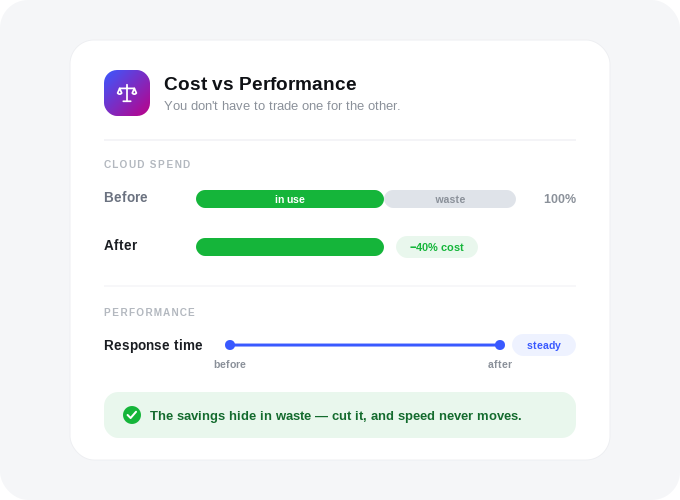
There's a persistent myth that cloud costs and performance are a straight trade-off — that the only way to spend less is to accept a slower, weaker system. In practice, the opposite is usually true. Most oversized cloud bills aren't buying performance; they're buying waste. Trim the waste and you often get a faster, leaner system that costs less. Here's where the savings actually hide.
Right-sizing: stop paying for capacity you don't use
The single biggest source of cloud waste is over-provisioning — instances and databases sized for a worst case that never arrives, running flat out at three per cent utilisation. Somebody, at some point, picked a generous size to be safe, and it was never revisited.
Right-sizing means matching each resource to its real workload. It sounds obvious, and it's routinely where the largest, easiest savings live. Nothing gets slower; you just stop paying for headroom you never touch. The trick is that it's not a one-off — workloads change, so right-sizing is something to revisit, ideally with real usage data guiding the decision rather than guesswork.
Elastic scaling: pay for peaks only at the peak
Traffic isn't flat. Most systems are busy for part of the day and quiet for the rest, busy on certain days and quiet on others. So why pay as if demand is constant?
Elastic infrastructure scales up when demand rises and — just as importantly — scales back down when it drops. The mistake most teams make is only automating the scaling up. They handle the busy moments beautifully and then keep paying peak prices through every quiet hour of the night. Real savings come from scaling down as aggressively as you scale up, so quiet hours cost quiet-hour money. Done properly, your bill starts to track your actual usage instead of your maximum imaginable usage.
Managed services: let the platform run the plumbing
Every service you run and maintain yourself carries a hidden cost: the engineering time to patch it, monitor it, secure it, and babysit it when it misbehaves. That time doesn't show up on the AWS invoice, but it's real, and it's often expensive.
Leaning on managed services shifts that operational burden onto the platform. There's less for your team to run, less to break, and frequently less raw infrastructure needed because the managed version is more efficient than a hand-rolled one. You trade a bit of control for a lot of saved time — and for most teams, most of the time, that's a good trade.
Efficient architecture: the compounding win
The deepest savings aren't a setting you toggle — they're a design. Systems architected to do more with fewer resources save money on every single request, forever:
- Caching takes load off the core, so you serve more from less.
- Asynchronous processing smooths spikes instead of provisioning for them.
- Sensible data access avoids hammering the database with work it shouldn't be doing.
- Right-sized data storage keeps you from paying premium rates for data that's rarely touched.
These decisions cost little to make up front and pay out continuously. They're also the hardest to retrofit, which is exactly why they're worth getting right early.
Quick wins versus structural wins
It helps to split cost work into two buckets. Quick wins are the low-effort, high-return moves: right-sizing obviously oversized resources, turning off environments nobody uses, deleting forgotten storage, adding scale-down rules. You can often knock a meaningful chunk off the bill in days.
Structural wins are the architectural changes — caching, async processing, moving to managed services, redesigning inefficient data access. They take more effort but they compound, and they're what keep the bill under control as you grow rather than just lowering it once.
Do the quick wins first for momentum and immediate savings. Plan the structural ones for lasting impact.
Make spend visible
You can't optimise what you can't see. The teams that keep costs under control are the ones that treat spend as something to monitor — attributable, visible, and watched — rather than a bill that arrives as a monthly surprise.
Observability into cost turns "why is it so high this month?" into "here's exactly what changed and where the money is going." When cost is visible per service, per environment, per feature, the waste has nowhere to hide, and the conversation shifts from panic to decision-making.
Efficiency as an engineering discipline
At Protechly, efficiency is one of our five engineering principles: every resource earns its place, performance and economy reinforce each other, and cost is designed in — not bolted on. The result is infrastructure that does more with less.
If your AWS bill is climbing faster than your business, that gap is almost always recoverable — usually without giving up a thing on performance. It starts with seeing clearly where the money actually goes.
Latest Articles