From idea to launch inside a product engineering roadmap
What it actually takes to turn a rough idea into a product people rely on; the five stages, and why each one earns its place.


From idea to launch inside a product engineering roadmap
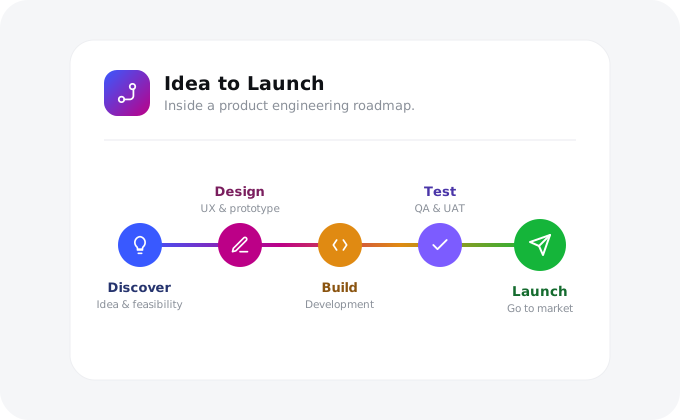
Plenty of teams can write code. Far fewer can take a rough idea and turn it into a product people rely on — on time, on budget, and built to last. The difference is rarely talent. It's process. Here's what a proper product engineering roadmap looks like, stage by stage, and why each one earns its place.
Discover — before a line of code
The most expensive mistakes are made before development starts, when nobody's paying attention. Discovery is where we pressure-test the idea: who it's for, what success looks like, what the real constraints are, and where the technical risks hide.
A good discovery answers uncomfortable questions early. What happens if this part is harder than we think? What's the one feature this product can't launch without — and what are we telling ourselves is essential when it isn't? Which assumptions are we betting the timeline on?
A week spent here routinely saves months later. You leave discovery with a clear scope, a realistic timeline, and a shared understanding of what you're actually building. What good looks like: everyone — founder, designers, engineers — could describe the product and its priorities the same way.
Design — decide how it should feel
Design isn't decoration; it's decision-making made visible. This is where the product takes shape as something people can react to — flows, screens, and the key interactions — before any of it is expensive to change.
The value of design is that it makes disagreements cheap. It's far better to discover that two stakeholders imagined completely different products while looking at a mock-up than to discover it three months into development. Getting the experience right on paper is a fraction of the cost of getting it wrong in code.
What good looks like: the core journeys are designed and agreed, and the team can point to a screen for every important thing the product does.
Build — in visible, shippable increments
Good engineering isn't a black box that goes quiet for three months and emerges with a surprise. We build in short, visible iterations, each one a working slice of the product you can see and steer.
That rhythm matters for two reasons. First, it means you're never guessing how the project is going — you can see it. Second, it means you're never more than a sprint away from changing direction, because working software is the most honest progress report there is. Cloud-native, secure by default, tested as we go: quality isn't deferred to the end, it's built into every increment.
What good looks like: at any point, there's something real to look at, and the next thing being built is the next most valuable thing — not whatever was easiest.
Test — quality as a stage, not an afterthought
Quality that's bolted on at the end is quality that isn't there. Automated testing, code review, performance checks, and security scanning run throughout — so bugs are caught when they're cheap to fix, not after your users find them.
There's a well-worn truth in software: a bug caught in development costs a fraction of the same bug caught in production. The teams that ship confidently aren't the ones that test hardest at the end. They're the ones that never let quality drift far from the work in the first place. By launch, the product has been exercised hard enough that release day is calm, not chaotic.
What good looks like: launch feels like a formality, not a gamble.
Launch — and then, operate
Launch is a milestone, not the finish line. A product that goes live and then goes unmonitored is a liability waiting to happen. We ship with observability, alerting, and a plan for the first days and weeks — because the period right after launch is when you learn the most and when problems are most likely to surface.
Then comes the part too many roadmaps ignore: operate. Real usage teaches you what version two should be. The product needs monitoring, maintenance, and steady improvement — and it needs someone paying attention when something goes wrong at 2am.
What good looks like: you can see how the product is behaving in the real world, and you're improving it based on evidence, not opinion.
Common ways it goes wrong
The failure modes are predictable, and each maps to a skipped stage. Skip discovery and you build the wrong thing well. Skip design and you build a confusing thing quickly. Skip disciplined building and you build something no one can safely change. Skip testing and you ship the right thing badly. Skip operating and you launch something that slowly falls over while everyone assumes it's fine.
Why the sequence matters
Each stage exists to make the next one cheaper and safer. The roadmap isn't bureaucracy — it's the shortest reliable path from idea to something people trust. Done properly, it doesn't slow you down; it stops you from doing expensive work twice.
At Protechly, this is simply how we build. Talk to us about where your idea sits on that path today.
Latest Articles