Modernise without the rip-and-replace risk
Modernisation doesn't mean betting the business on a big-bang rewrite. How phased migration moves you to the cloud without the downtime.


Modernise without the rip-and-replace risk
The word "modernisation" makes a lot of business owners flinch — and for good reason. It sounds like ripping out the systems that currently keep the lights on and betting everything on a big-bang replacement that goes live one nervous morning. That version of modernisation is risky, expensive, and mostly unnecessary. There's a better way to do it.
Why big-bang replacements go wrong
The all-at-once rewrite fails for a predictable reason: it asks you to switch off something that works and switch on something that has never faced real users, real data, or real load — all at the same moment. Every risk lands on one date.
And the risks are rarely the ones you planned for. It's not the feature you spent months on that breaks; it's the obscure edge case the old system quietly handled that nobody documented, because the person who understood it left years ago. When something breaks — and something always does — there's no gentle fallback. The business feels every minute of it, and so do your customers.
Big-bang rewrites also tend to freeze the business. For the entire duration of the rewrite, you're pouring effort into rebuilding what you already have, rather than improving it. Competitors keep moving while you stand still, hoping the leap lands.
The phased alternative
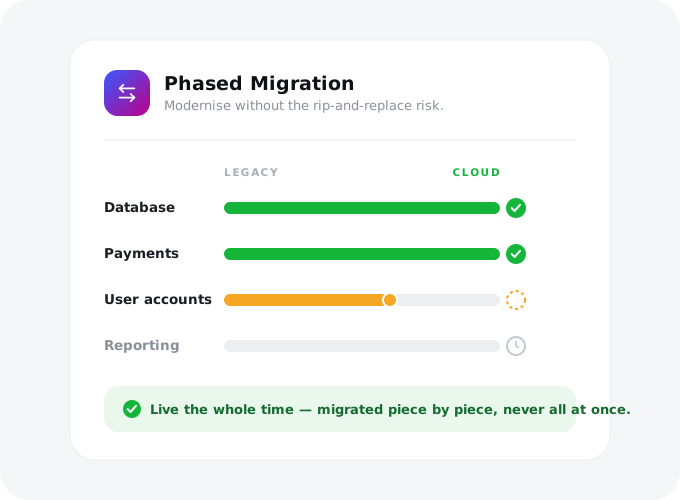
Staged modernisation flips the risk profile. Instead of one enormous leap, you take a series of small, controlled steps — each one tested, each one reversible, each one delivering value on its own. The old system keeps running while the new one is built and proven alongside it. You move workloads across piece by piece, on a timeline you sign off, with no surprise downtime.
By the time the last piece moves, the "new" system isn't new at all. It's been quietly proving itself for weeks. There's no single terrifying cutover — just a gradual shift from old to new that customers never notice.
The strangler approach, in plain English
There's a well-known technique for this, and its name is more dramatic than the idea. You build the new system around the edges of the old one, redirecting one piece of functionality at a time. Gradually, more and more runs on the new system and less on the old, until eventually the old system has nothing left to do and can be switched off quietly.
The beauty of it is that at every stage you have a working business. If a piece doesn't behave as expected, you route back to the old system and try again. Nothing is ever bet on a single moment.
What the path actually looks like
Every modernisation is different, but the shape is consistent:
- Assess. Map what you have, where the risks are, and what to modernise first. This is where the surprises get found — on purpose, early.
- Plan. A roadmap that sequences the work so the business is never disrupted, with clear stages and clear sign-off points.
- Migrate. Systems and data move in safe, tested stages, each one verified before the next begins.
- Optimise. Along the way, we re-architect for scale, automate the manual work, and tune everything for cost and performance on modern cloud infrastructure.
- Operate. Then we keep it running — monitored, maintained, and improved.
Crucially, you're never in the dark and never past the point of no return.
What "phased" doesn't mean
Phased doesn't mean slow, and it doesn't mean endless. A good phased migration has a clear destination and a finite timeline — it's just broken into steps that each stand on their own. It also doesn't mean running two systems forever; the whole point is that the old one is progressively retired, not permanently propped up beside the new. Done right, phased is the faster route to safe, not a way of avoiding the finish line.
What you're left with
Lower running costs, because you stop paying for idle, over-provisioned infrastructure. Less manual work, because automation handles what your team shouldn't have to. Room to scale, because the foundations are finally built for it. And stronger security, because modern systems are simply easier to protect and to prove compliant.
Same business, better engine — swapped in without stalling the car.
The honest first step
Modernisation doesn't have to be a leap of faith. It should start with a clear-eyed look at what you're running today and a plan you can actually see. At Protechly, that assessment is where we begin — no obligation, no rip-and-replace. Just a path forward you can trust, taken one safe step at a time.
Latest Articles