Secure by design. What "defence in depth" really means
Real security isn't a padlock you bolt on at the end. What 'defence in depth' means, and why it's the only approach that holds.


Secure by design. What "defence in depth" really means
Security has an image problem. It gets treated as a feature — a padlock icon, a box to tick before launch, something you "add" once the real work is done. That mindset is exactly how breaches happen. Real security isn't a layer you bolt on. It's a way of building. The principle behind it has a name: defence in depth.
One wall is never enough
Imagine protecting a building with a single, very strong front door — and nothing else. Get through that one door and everything inside is yours. That's how a surprising number of systems are built: one strong control, and soft everything behind it.
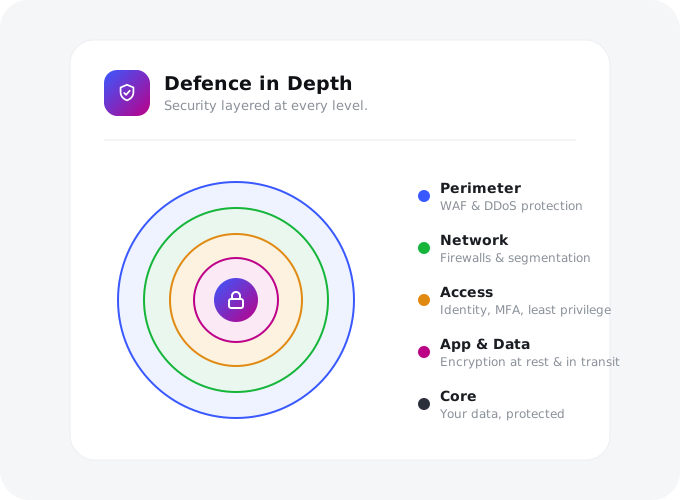
Real security works like a well-protected building, not a single door. There's a fence, then locked doors, then alarms, then a safe for the valuables, then cameras watching all of it. An intruder who gets past the fence still faces the doors. Past the doors, the alarms. Each layer assumes the one before it might fail — and makes sure that failure isn't the end of the story. That's defence in depth: multiple independent layers, each one buying you safety even if another gives way.
What the layers look like
In practice, defence in depth runs from the code all the way to the cloud:
- Secure coding and code review stop vulnerabilities getting written in the first place — the cheapest place to catch them.
- Strong identity and access controls ensure people and services can only reach what they genuinely need.
- Encryption, in transit and at rest, means that intercepting or stealing data achieves nothing without the keys.
- Network hardening limits what's even reachable, so much of your system simply isn't exposed to attack.
- Automated scanning checks code and dependencies continuously, catching known vulnerabilities as they emerge.
- Continuous monitoring and response means that if something does slip through, it's seen and stopped fast, not discovered months later.
No single one of these is the answer. Together, they're formidable.
Least privilege: the quiet hero
The most underrated security principle isn't dramatic. It's least privilege — the discipline of giving every user, every service, every component only the access it actually needs, and nothing more.
Most breaches don't spread because attackers are brilliant. They spread because everything had access to everything. One compromised account or service turns out to be a master key, because nobody ever restricted what it could reach. Tighten that, and a foothold stays a foothold instead of becoming a disaster. Least privilege is the difference between "an attacker got into one thing" and "an attacker got into everything."
What attackers actually do
It helps to understand how real attacks unfold, because it explains why layers matter. Attackers rarely smash through the front. They look for the weakest point — an unpatched dependency, a leaked credential, a misconfigured setting, an employee tricked into clicking a link. Once in, they move sideways, quietly, looking for more access and more valuable data, often for weeks before doing anything visible.
Every layer of defence does one of two things: it makes that initial foothold harder to get, or it makes moving from the foothold to something valuable harder to achieve. A single wall stops only the first step. Depth stops the journey.
Where teams get it wrong
A few patterns show up again and again. Treating security as a final-stage checklist, so it's rushed and shallow. Protecting the perimeter heavily while leaving everything inside wide open. Granting broad access "temporarily" and never walking it back. Collecting far more sensitive data than the product actually needs, turning a minor breach into a major one. And assuming that because nothing has gone wrong, nothing is wrong — when in reality no one is watching closely enough to know.
None of these are exotic. They're ordinary shortcuts, and they're exactly what attackers rely on.
Secure by design, not by patch
The common thread is timing. Security engineered in from the first commit is cheap, coherent, and effective. Security patched on after the fact is expensive, brittle, and full of gaps.
"Secure by design" simply means treating protection as a design requirement from the start — as fundamental as whether the thing works at all. It's cheaper, because you're not retrofitting. It's stronger, because security is woven through the system rather than wrapped around it. And it's calmer, because you're not permanently one discovery away from a scramble.
Why it matters beyond the tech
Strong security protects more than data. It protects your reputation, your users' trust, and your ability to grow without fear. A single serious breach can undo years of trust-building overnight — and in a world of the Australian Privacy Act and GDPR, it can carry real legal and financial consequences too.
At Protechly, security isn't a phase — it's engineered into every layer of what we build, from the first line of code to the infrastructure it runs on. Because the best breach is the one that never gets a foothold.
Latest Articles