Staff augmentation vs a dedicated squad.
When your roadmap outgrows your team, which model fits individual engineers, a dedicated squad, or a managed project? A quick way to decide.


Staff augmentation vs a dedicated squad.
When your roadmap outgrows your team, the instinct is to hire. But hiring senior engineers takes months you often don't have, and a permanent headcount is a long commitment for what might be a temporary need. Bringing in outside engineering capacity solves the timing problem — but "outside help" comes in a few different shapes, and picking the wrong one wastes money and momentum. Here's how to choose.
Staff augmentation: engineers who join your team
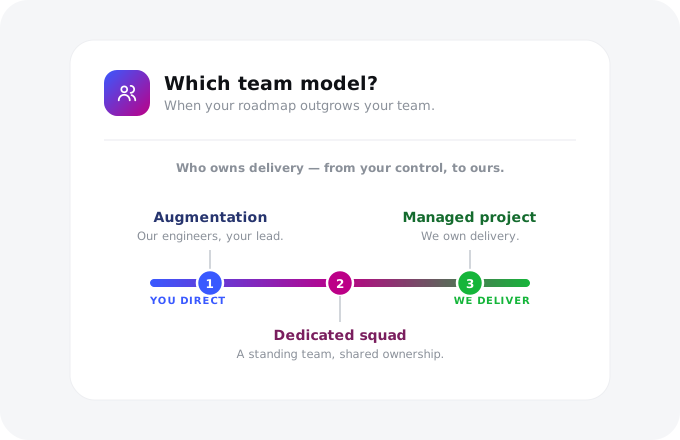
Staff augmentation means individual specialists slotting into your existing team. They join your standups, work your board, use your tools, and are managed by you — they're simply extra hands and extra expertise, embedded in the way you already work.
This fits when you have a functioning team and a clear plan, and what you're missing is capacity or a specific skill — cloud, security, mobile — you don't have in-house. You keep full control; you just have more of the right people. It's also the most flexible option: scale the number of engineers up or down as the roadmap changes, without the weight of permanent hires.
The thing to be honest about is that augmentation leans on your management. Because these engineers work within your process, they're only as effective as the direction and structure you give them. If your team is well-run, augmentation multiplies it. If it isn't, augmentation multiplies the chaos too.
Dedicated squad: a ready-made team
A dedicated squad is a cross-functional unit — engineers, QA, and a lead — that operates as one and takes ownership of a whole workstream or product area. Rather than filling gaps in your team, it acts as a team.
This fits when you have a distinct body of work that can be owned end to end, and you'd rather hand over a product area than manage individuals. The squad brings its own agile rhythm — sprints, ceremonies, reporting — and delivers as a coherent group from day one. You get output without having to build and run the team yourself.
The trade-off is that a squad works best with a clear mandate. Give it a well-defined area to own and it flies. Try to split it across a dozen unrelated small tasks and you lose the very thing that makes it valuable — its ability to move as one.
Managed project: buy an outcome
There's a third option worth knowing. A fully managed project is where an outside team owns a defined deliverable — to an agreed scope and timeline, with the project management, reporting, and quality all handled for you, and a clean handover at the end.
This fits when the work is well-defined and you'd rather buy an outcome than manage a process. You're not adding to your team or directing day-to-day work; you're commissioning a result. It's the lowest-management option — and it depends most on getting the scope right up front.
A quick decision table
Your situationBest fitWorking team, clear plan, need more capacity or a specific skillStaff augmentationA whole product area you'd rather delegate as a unitDedicated squadA well-defined deliverable you'd rather buy as an outcomeManaged project
Or, in one question: do you need more of your team, another team, or a result?
Onboarding — the part people forget
Whichever model you pick, the first few weeks decide how well it works — and it's the part most often underestimated. External engineers can only move fast if they can get into your tools, understand your codebase, and know who to ask. A little investment here pays off enormously: clear access, a quick tour of the system, someone available for questions, and a small first task to build momentum. The teams that get frustrated with outside help are almost always the ones that dropped people in with no runway and expected instant output.
Red flags to avoid
A few warning signs, whichever model you choose. Be wary of anyone who won't tell you who's actually doing the work, or who's vague about seniority. Watch for a lack of transparent reporting — you should always be able to see progress. Avoid arrangements with no clear way to scale down; flexibility is half the point. And treat "we can start Monday with no questions" as a warning, not a selling point — good engineers want to understand the problem first.
What doesn't change
Whichever model you choose, the fundamentals should be the same: senior, vetted engineers; agile delivery; open communication between teams; transparent reporting; and the ability to scale on demand. The model changes how the people plug in — not the quality of what they do.
At Protechly, we offer all three — augmentation, dedicated squads, and managed projects — because the right answer depends on your team, not our template. Tell us where you need capacity and we'll match the model to it.
Latest Articles