Web app, native app, or both? A founder's decision guide
A simple framework for choosing between a web app, a native app, or both — based on your users and your runway, not the hype.


Web app, native app, or both? A founder's decision guide
"Should we build a web app or a native mobile app?" is one of the first real forks in the road for any digital product — and one of the easiest to get wrong. Pick the wrong path and you either overspend building things your users don't need, or underbuild and hit a wall the moment you try to grow. Here's a straightforward way to make the call.
Start with where your users actually are
Forget the technology for a moment. The question that matters is how and where people will use your product. If it lives in short, on-the-go bursts — notifications, camera, location, offline use — that's native mobile territory. If it's something people sit down to use, often at a desk, across devices they don't want to install anything on, that's the web.
Most products lean clearly one way. The trouble starts when founders assume they need everything, everywhere, on launch day.
A good exercise: describe, in one sentence, the single most common moment someone will use your product. "A warehouse manager checking stock on their phone between aisles" points somewhere very different from "an operations lead building a report on a Monday morning." That one sentence usually decides the platform.
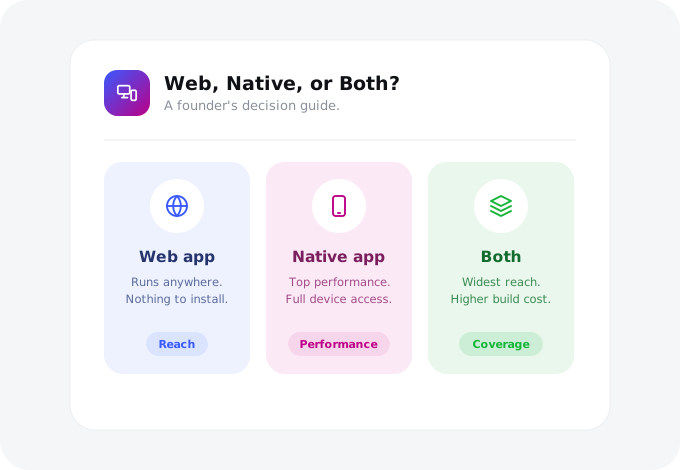
What a web app gives you
A web application is the fastest way to reach the widest audience. There's nothing to download, nothing to get approved by an app store, and one codebase serving every device with a browser. Updates are instant — you ship, and everyone has the new version, with no waiting for users to update or for a store to review your release.
For B2B tools, dashboards, internal systems, and most first releases, a well-built web app is usually the right and cheapest starting point. It's also the easiest to iterate on: when you're still learning what your product should be, being able to change it instantly for everyone is a genuine advantage.
The trade-offs are real, though. Web apps have more limited access to device features, and while modern browsers have closed much of the gap, deeply native experiences — the kind that feel instant and physical — are still harder to match on the web.
What native mobile gives you
Native apps earn their cost when the experience depends on the device: fast, fluid interfaces, reliable push notifications, camera and sensor access, and genuine offline capability. They also signal permanence — an icon on the home screen is a daily reminder your product exists, and a level of commitment users notice.
If mobile engagement is the heart of your business model — if you need people opening your product daily, receiving timely notifications, or using it where there's no reliable connection — native isn't a luxury. It's the product.
The cost is higher and the iteration slower. You're building for two platforms (iOS and Android), each with its own conventions, and every update goes through an app store review before it reaches anyone. That's the price of the deeper experience.
A word on cross-platform frameworks
You'll hear about frameworks that let you build once and run on both iOS and Android — and sometimes the web too. Used well, they can genuinely cut the cost of going native, and for many products they're the pragmatic choice. Used badly, they promise "write once, run anywhere" and deliver "write once, debug everywhere." The right answer depends on how native the experience needs to feel and how much platform-specific behaviour you need. It's a real option, not a magic one.
The "both" trap — and how to avoid it
"Both" sounds safe. It's often just twice the cost and half the focus. The smarter version of "both" is sequencing: build the platform that proves your idea first, on solid shared foundations, then extend to the other when the demand is real and paid for.
A cloud-native backend built properly will serve a web front end today and a native app tomorrow without a rebuild in between. That's the key move — invest in a solid, shared foundation once, and the question stops being "web or native" and becomes "which front end, and when." You keep your options open without paying for all of them at launch.
Questions to ask before you decide
- What is the single most common moment someone uses this?
- Does the experience genuinely need the camera, notifications, sensors, or offline use?
- How often will we want to change the product in the first year?
- What's our runway — can we afford to build and maintain two platforms well?
- Where are our competitors, and is that where our users actually are, or just where everyone assumed they'd be?
How we'd approach it
At Protechly we design the foundation once — a secure, scalable, cloud-native backend — then build the front ends your users actually need, in the order that makes commercial sense. Web first, native when it counts, or both when the case is clear.
The point is to decide deliberately, not by default. Choose based on your users and your runway, not on what a competitor happened to build.
Latest Articles