Why your MVP shouldn't cut corners on architecture
Trimming features keeps an MVP lean. Trimming architecture just delays an expensive rebuild. Here's where to cut, and where not to.


Why your MVP shouldn't cut corners on architecture
Every founder is told the same thing about a minimum viable product: ship fast, learn faster, don't over-build. It's good advice — right up until "move fast" quietly becomes "we now have to rebuild the whole thing." The decisions you make in the first few weeks of an MVP don't just shape version one. They decide whether version ten is a series of clean releases or an expensive rewrite.
Cutting corners on features is smart. Cutting corners on architecture is a loan you repay with interest.
The difference between scope and structure
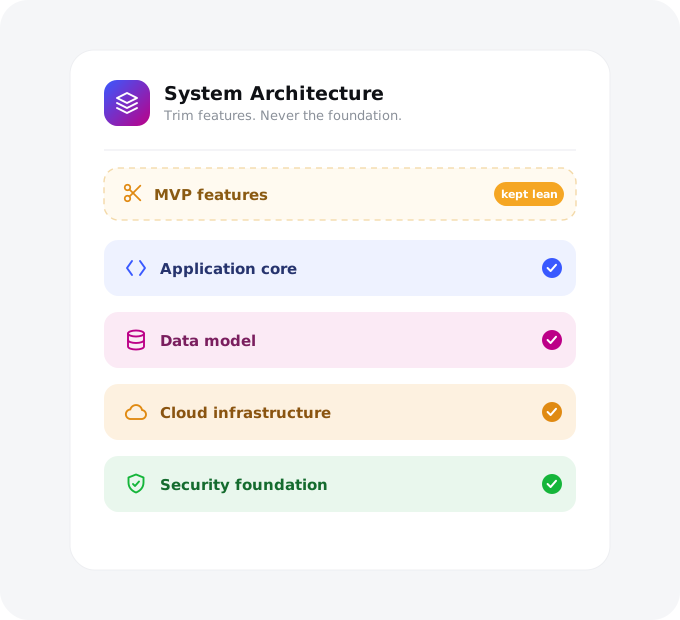
There are two things people lump together when they talk about a "lean" MVP. The first is scope — how much your product does. Trimming scope is exactly right: fewer features, fewer edge cases, faster to market. The second is structure — how your product is built underneath. That's the part you shouldn't trim.
A small, well-structured system is cheap to extend. A small, badly structured one is cheap only until the day you need it to grow. You can always add features to good foundations. You can't easily add foundations to a product already carrying real users.
Think of it like building a house. You can move in before the second storey is built, before the garden is landscaped, before half the rooms are furnished. What you can't do is pour a foundation designed for a cottage and later decide you want an apartment block on top of it. Scope is the rooms. Structure is the footings.
A quick test: are you building a prototype or a product?
There's a useful distinction that clears up most of the confusion. A prototype exists to answer a question — will people want this? It can be thrown away, and often should be. A product exists to be used, extended, and depended on. The mistake isn't building a prototype. The mistake is building a prototype, discovering it works, and then never replacing the scaffolding underneath before piling real users onto it.
If you genuinely just want to test an idea with a handful of people, build the cheapest thing that answers the question and be ready to bin it. But the moment you intend to keep and grow what you've built, it's a product — and it deserves foundations.
What "good enough" architecture actually looks like
Good early architecture isn't gold-plating. It's a handful of decisions that cost almost nothing up front and save you enormously later:
- Stateless services, so you can add capacity by adding instances rather than redesigning the system.
- A clean separation between data and logic, so changing one doesn't mean untangling the other.
- Environments provisioned as code, so you can recreate or scale your setup reliably instead of hand-building servers nobody can reproduce.
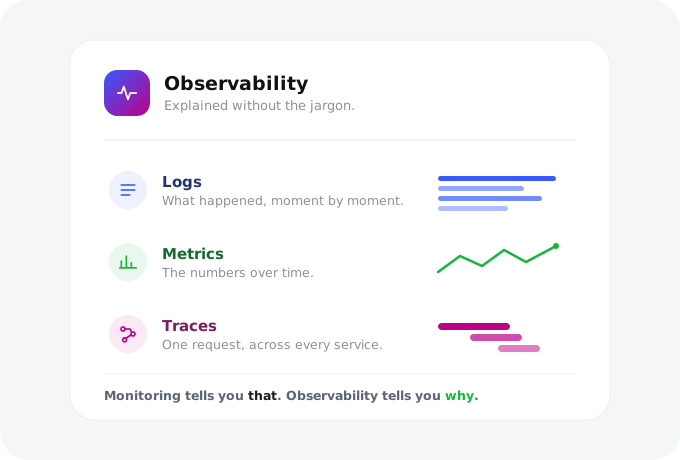
- Observability from day one, so when something breaks — and it will — you can see why in minutes rather than guessing for hours.
- Sensible security defaults, because retrofitting security onto a live product is far harder than building it in.
None of that slows an MVP down. It's the difference between a prototype and a product that happens to be small.
When cutting corners is actually fine
To be fair, plenty of corners are safe to cut early — and cutting them is good discipline. You don't need microservices when a well-structured single application will do. You don't need to support ten languages, five payment providers, or every edge case on launch day. You don't need the scale architecture of a company a hundred times your size. Over-engineering is its own trap, and it's just as expensive as under-engineering.
The skill is knowing which corners are cosmetic and which are structural. Cosmetic corners you can always come back to. Structural ones quietly set a ceiling on everything you build afterwards.
The rebuild tax
The most expensive words in software are "we'll fix it later." Later, you have paying customers, live data, and a team afraid to touch the core. The shortcuts that saved a fortnight at the start now cost months — and every month is spent rebuilding what you already had, instead of building what's next.
The rebuild tax is brutal precisely because of when it lands. It arrives exactly when things are going well — when you've found traction and should be pressing your advantage. Instead, you're stuck re-laying foundations under a house full of people, unable to move as fast as the opportunity demands. Competitors who got the structure right the first time simply keep shipping.
We've seen this play out enough times to be blunt about it: the cheapest time to get the foundations right is before anyone is relying on them.
Building an MVP that can grow up
At Protechly, we build MVPs the way we build everything — engineered to scale from day one, even when day one is small. That means a lean feature set on solid foundations: cloud-native, secure by default, observable, and ready to grow the moment your idea proves itself.
The point isn't to build more. It's to build the small thing properly, so the big thing never has to start from scratch. Ship fast. Just don't ship something you'll have to throw away.
Latest Articles